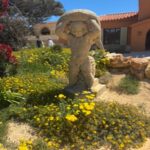
Paul Ricard’s private island, ‘Île de Bendor’ in the South of France, is an exclusive island, bought by the millionaire drinks magnate in the 1960s, in homage to his humble Marseille roots.  In this small island, not more than 1 mile in circumference, he built two hotels, an art gallery, a small fishermen’s port, and placed statues throughout that referenced his love of art and the Mediterranean Sea. His motto in life was, “no pain, no gain” and in the island’s heady past, he welcomed distinguished guests such as Salvador Dali, Marcel Pagnol and Josephine Baker.

Ricard, whose father was a wine merchant, grew up surrounded by the Marseille hills and he was in awe of the wonderful landscape: the deep blue sea and the sheltered coves, the scent of rosemary, lavender, pine in the air and, of course, the bright yellow flowers of absinthe and fennel.  He instinctively knew that in these fragrant herbs, there lay a fortune. Using a mixture of aniseed, liquorice and herbs, he created an affordable aperitif (incidentally once banned in France for causing madness and hallucinations during WW1) and christened it Paul Ricard’s Pastis. This was the 1930s, and served with water, then ice, it had a milky-yellowy glow, and it took the world by storm.  A former art student, Paul Ricard designed the logo using the colours of yellow and blue: as vibrant as the absinthe flower against the deep blue backdrop of the Mediterranean Sea.
His fortune made, he spent his later years of life with his family on the ‘île de Bendor’, where he returned to his first love of painting.  He created an art gallery to display his portraits of family members and followed his second love for motor racing, by establishing the Paul Ricard circuit in Le Castellet, a town not far from Marseille, that still holds competitions today.  By the time Ricard passed away aged 88, the island of Bendor had become a favourite of the rich and famous. In the discreet town of Bandol, it was usual to spot the ‘beautiful people’ arriving at the port in their blacked-out limos to be taken over to the island’s private parties or international conferences.  The New York Times best-selling author Colleen Hoover was one distinguished guest and as she said of her visit, she was ‘living the dream’.

However, by the 21st century the island required a refurbishment, and in 2021, the great grandson of Paul Ricard, Marc de Jouffroy, announced his intention, on behalf of the trustees, to modernise it, with an eco-friendly dynamic, and a desire to cater for not just the super-rich, but everyday people too.  In May 2026, it was officially opened for business, and on a recent visit, I found it equally as enchanting, as it had been when I first visited 15 years ago.
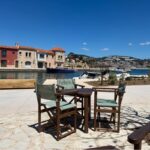
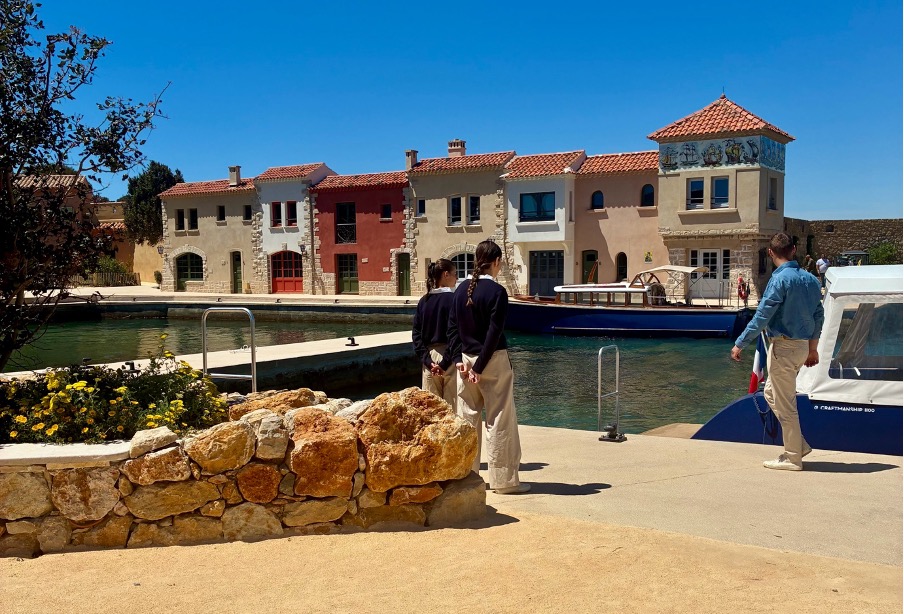
I boarded the freshly painted ferry, fully electric, with Paul Ricard branding for the 7-minute trip.  Approaching the fishing port, the miniature row of rainbow-coloured houses has a welcoming feel.  The staff are young, bronzed and dressed head to toe in Ralph Lauren: navy blazers, white shirts and waist pleated taupe trousers. Some are there to greet foot passengers; others are whizzing about in electric buggies delivering essentials from one part of the island to the other.  I was served a delicious ”café crème” coffee with a freshly baked croissant and a bowl of nuts. It felt a bit like Portmeirion in Wales: silent, still and surreal.

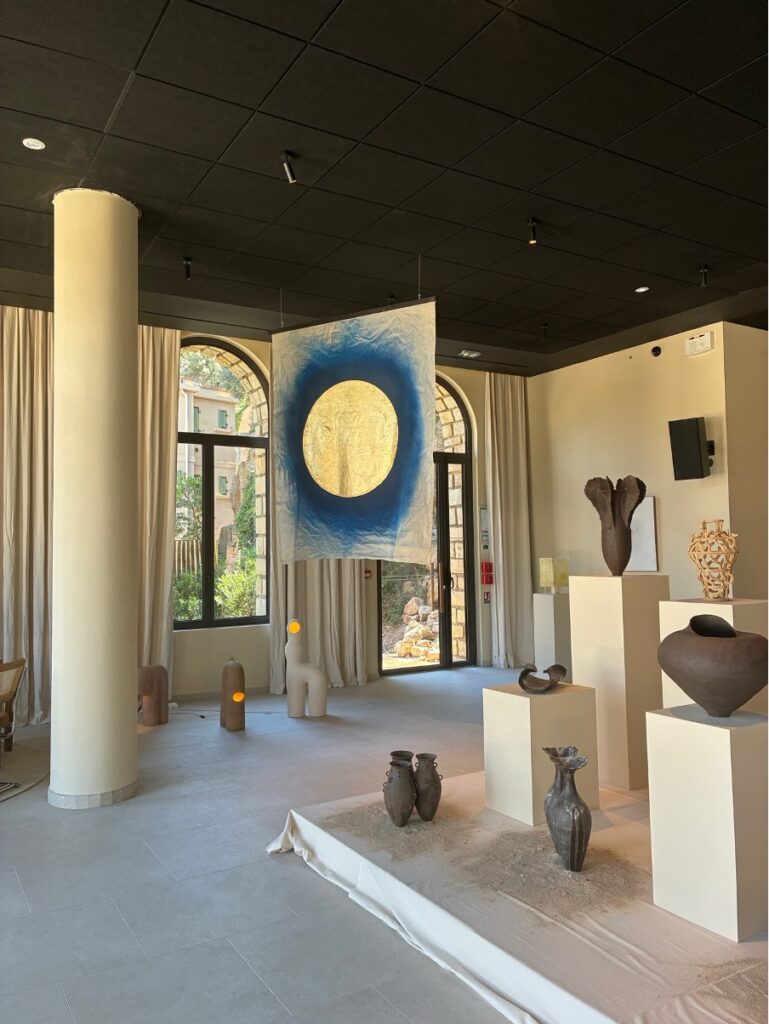
The art gallery had a couple of large installations, with a target audience, I suspected, being the super-rich. An outdoor seating area, displayed inside the gallery, was made of stone and decorated with gold leaf.  A large textile art piece was suspended from the ceiling showing a gold leaf sun, on a backdrop of blue painted linen. Curved pottery vases and bowls were on display, created by a Croatian artist who had a residency on the island. She was friendly and inspired by the Mediterranean, only the eastern side: the Adriatic.
The Provencal style restaurant shaded by hessian canopies was busy. Inside, an open cuisine revealed the Michelin starred chefs working hard amongst the steam and sizzle of the dishes they were preparing. Culinary works of art I imagined, and of course, inspired by the sea.

I walked towards the 90 bedroomed hotel to the west of the island. Its brutalist design is in sharp contrast to the soft Provence style architecture elsewhere, but the artist in Paul Ricard would have approved that its distinctive structure has been retained. Inside it has been elegantly restored but I was unable to take a closer look, as it was out of bounds.  “Interdit” said security politely.  As was the hotel to the west of the island, the more exclusive boutique hotel named Delos. Instead, I took a walk along the nature scented coastal trails, and that’s where I found the true island paradise of Paul Ricard.
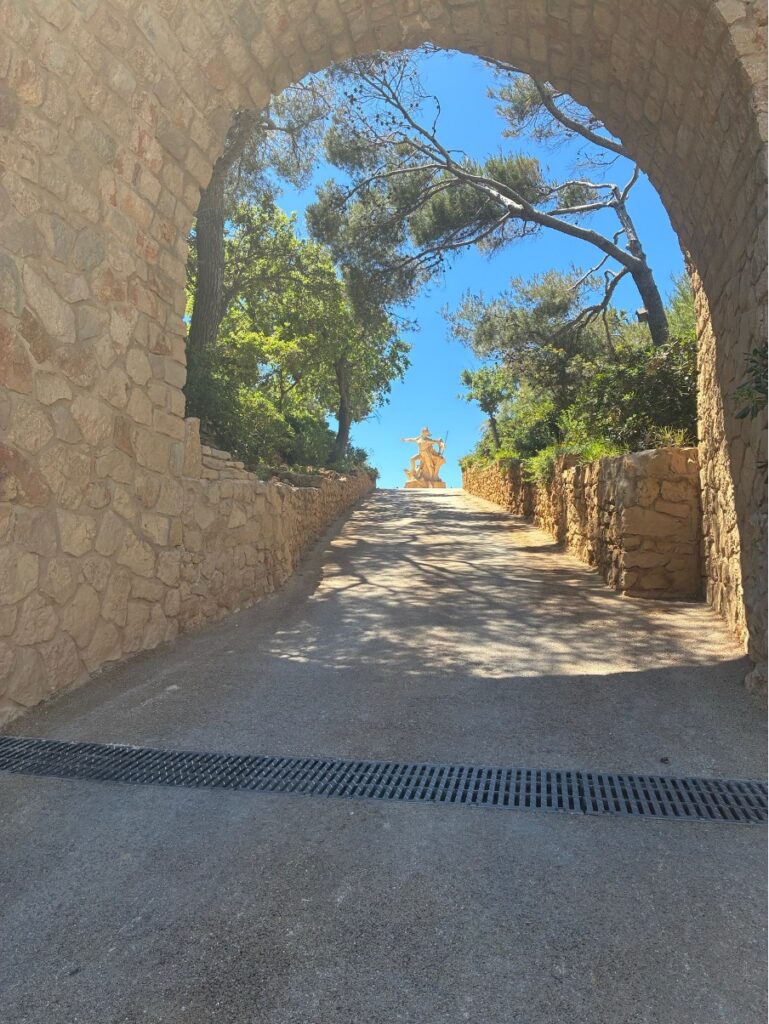
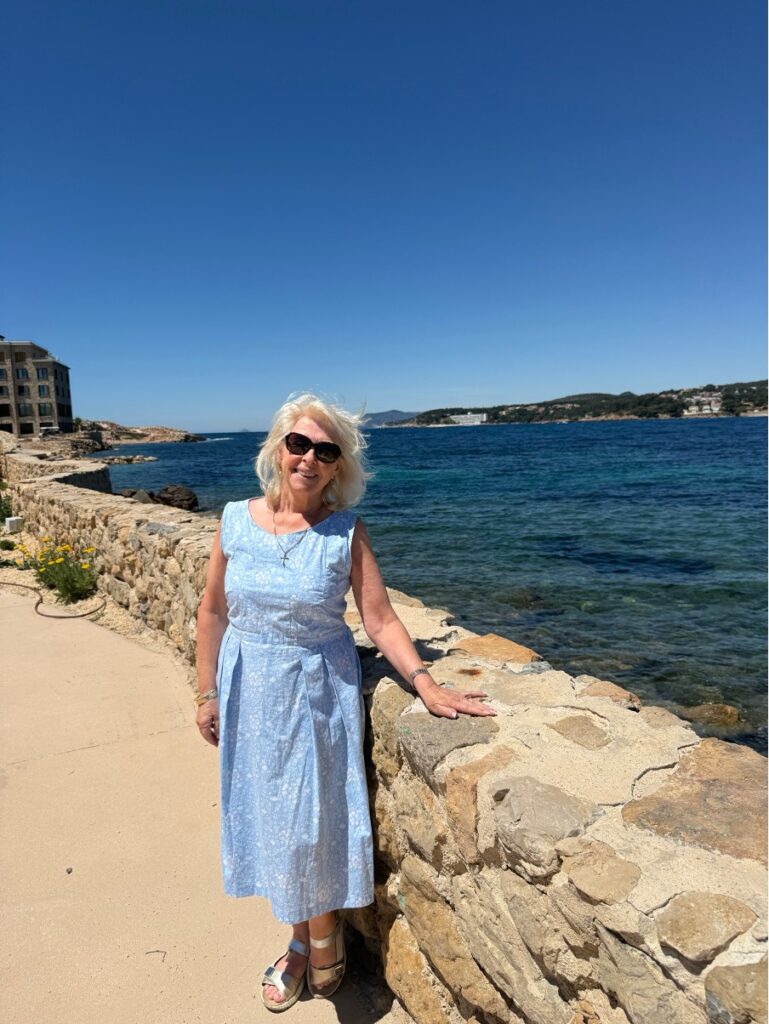
Just beyond the magnificent statue of Neptune, there lay a hidden path, with steps dipping down to the sea, lined with rocks and Mediterranean shrubs shaped by the wind. Growing there were glorious yellow absinths, golden marigolds and pink marguerites. The scent of salt sea spray as the waves dashed the rocks below was magical. On the far side of the island overlooking the open sea, that feeling of escape, which is every island’s secret ingredient, I found there. I felt Paul Ricard was truly present in this captivating setting, and the island of Bendor is a real homage to his love of art and the Mediterranean Sea.