Visit with grandchildren
It’s that time of year again when grandparents come in handy. They can be seen at sports centres, playgrounds and museums and are usually internally marking time. “That’s Week 1 over.” On the other hand, they know it’s one of life’s greatest pleasures to be healthy enough to spend summer holidays with the grandchildren. It’s a ‘rite of passage’ kind of thing.
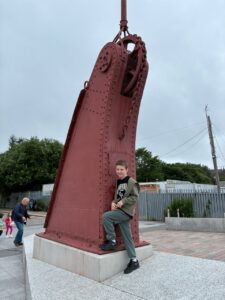

It’s even better when grandchildren can teach you things. On a recent visit to the Govan Stones Church in Glasgow, my 9-year-old grandson pulled me literally away from the Govan Road entrance towards the humungous Govan/Partick Pedestrian Bridge that spans the River Clyde. We walked across the magnificent bridge, and looking upwards towards the soaring masts he told me about the Glasgow engineers that designed and built it, and how they had preserved the original iron pulleys that had drawn the ferries by huge chains back and forth across the river in days of yore. His dad had told him all about this. I was impressed. Now, in 2026, it was wonderful to see joggers, cyclists and wheelchair users making their way across the bridge, into the heart of Glasgow’s west end, by way of the Transport Museum.

But it was the Govan Stones we had come to see, and I was keen to follow the Clyde walkway trail that would lead to this quiet, quaint, historically rich place of repose. Tucked away amongst medieval type buildings, 20th century shipyards, and the awe-inspiring 21st century pedestrian bridge, lies the picturesque church originally dedicated to St Constantine in the oldest churchyard in Scotland. It’s got a humble feel to it and information panels line the pathway as you approach.
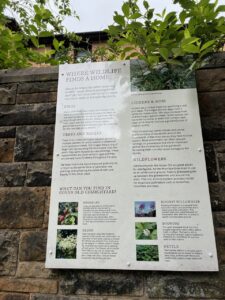
They tell visitors that this is a sacred place where ancient Kings of Strathclyde were buried, and that no less than 6 churches have been built on the site over 1500 years. It feels silent and serene, like a place that time forgot. Indeed, situated only a stone’s throw from Fairfield’s shipyard, where the hard labour of riveters and welders once rang out, this teardrop shaped graveyard was left to sleep and become overgrown, a bit like the Sleeping Beauty fairytale. However, the wildflowers and fauna blossomed, and there is still a faint sweet smell of honey in the air, from the elder and lime trees with flowers laden with pollen that surround this sheltered treasure.
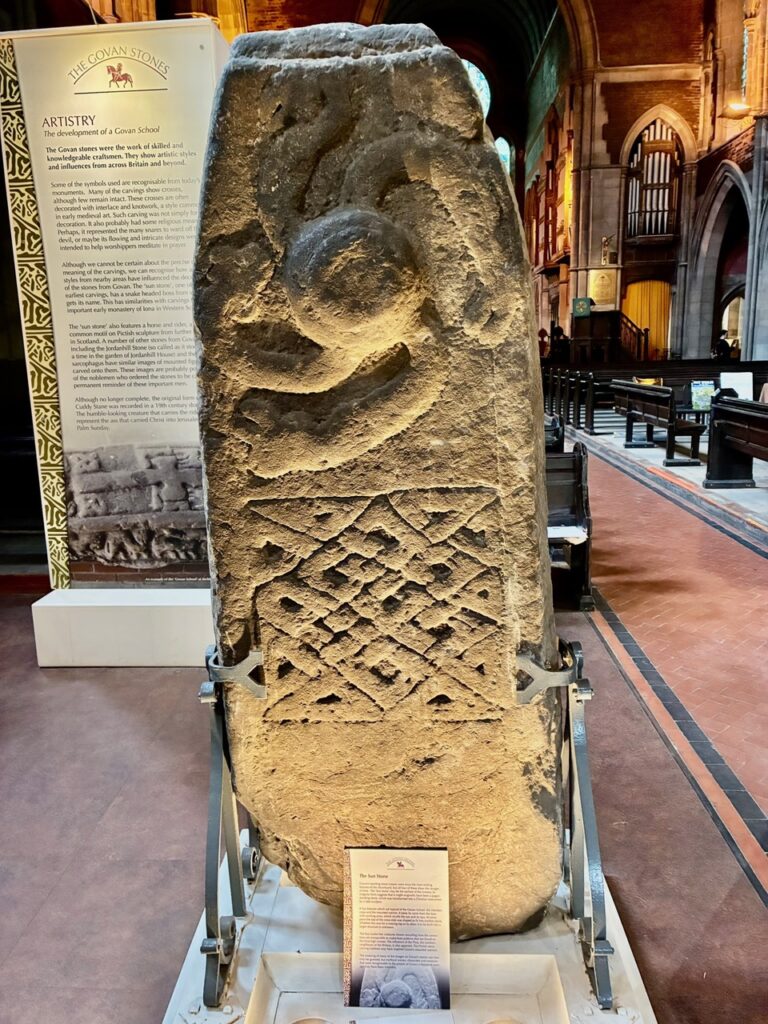
Inside there was an extremely warm welcome from the Museum Assistant and popular historian, Scott McMullen. An unusual Sun Stone stands at the entrance and is impressive in its size and carvings. A sun with four serpent-like creatures swirling around its centre form the top part of the stone, and below is the recognisable Celtic interlaced fret work.
	“This stone has most certainly been adapted from Pagan times, through to the Christian era and then by Vikings. It would have been a marker, a direction stone, telling travellers that they had reached a sacred site,” he explained. “The serpents were a symbol of redemption and are quite crudely worked when compared to other similar stones found in Iona and Islay.”
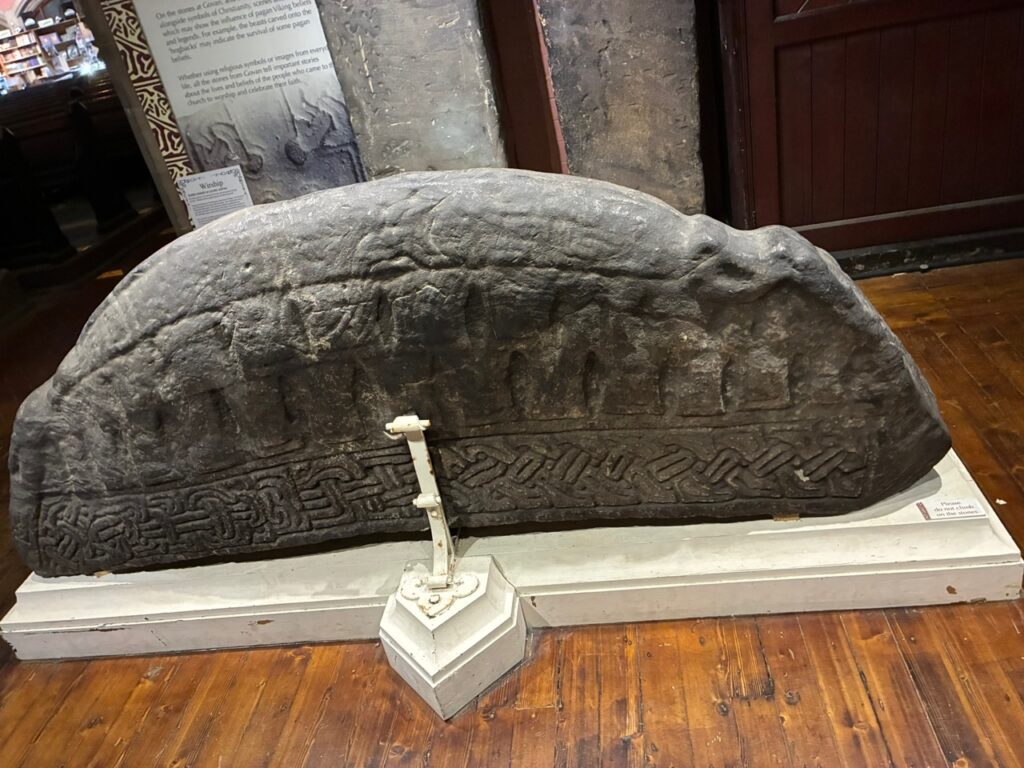
Many of the stones found in the Govan church are standing, but the most remarkable ones are the recumbent horizontal hog-backed collection.
“These form the largest group found in Scotland and are physically larger and heavier than those found anywhere else in Britain,” Scott continues. “The five hump-backed stones on display had been hidden in a shipyard plating shed and uncovered by a fourteen-year-old schoolboy, working as part of a community archaeology and heritage programme. These stones would have originally been personal memorials designed to lie along the grave of distinguished people living in the area. What archaeologists and historians can’t say for sure is that the hogback stones indicate a Viking settlement, but perhaps its only time before we can say this for certain. The stones date to the 10th century, so they are clearly Viking in origin and combine the Celtic/Christian traditions with Norse mythology. They are made with one solid block of sandstone, and each are formed into the shape of an upturned Viking boat that would have once revealed a dragonhead carved on the ridge. Below the ridge, roof-tile shapes can still be seen. These represent home and hearth, so important to the Vikings, and finally, at the bottom, a border of highly decorative and intricate Celtic/Norse designs.”
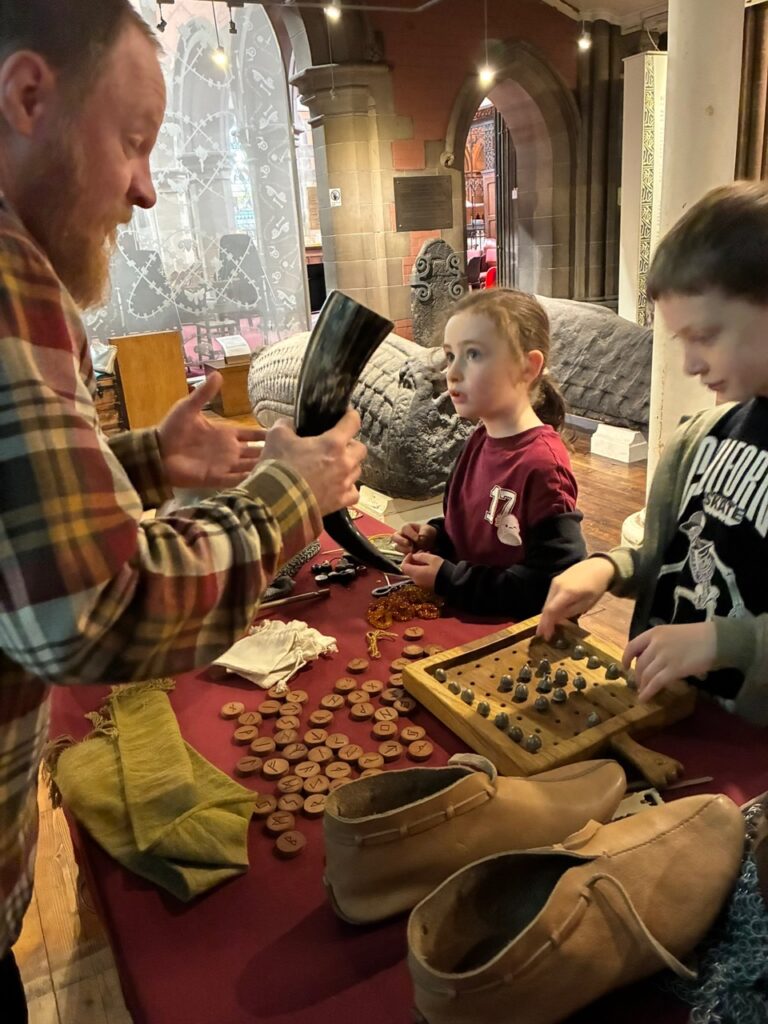
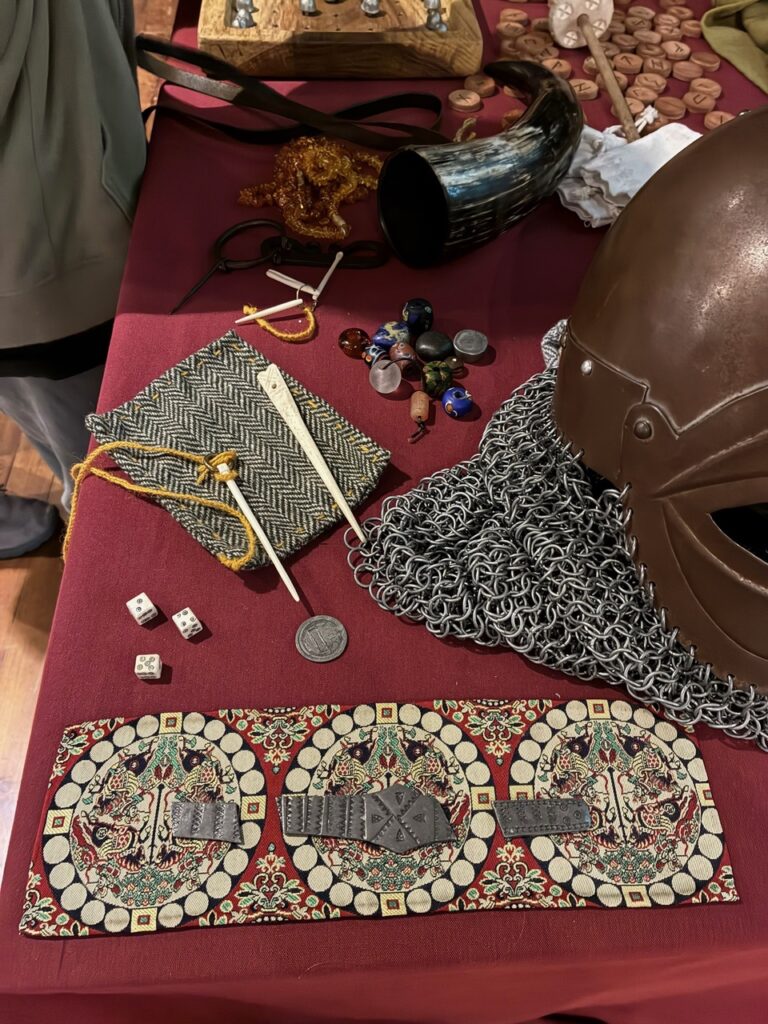
At the interest table for children there are a variety of objects: a silver hacking bracelet that Vikings used to ‘hack’ a piece off to pay for things, the large bone needles that were used to stitch fabrics, and the chainmail helmets, swords and shields. There is also a replica of a Viking strategy peg-board game, called Hnefatafl, and a shop that sells local crafted products.
“We are a grass roots organisation,” explained Scott, “we are growing every year. We are mainly staffed by volunteers and are run by the Govan Heritage Trust. We don’t come under any official museum status, therefore we don’t receive central funding. We have found that our Book Festival that runs through July and August and our annual programme of talks, presentations and musical evenings are becoming more popular, but with a venue size of 250 capacity and only one toilet, we are hampered by what we can do. However, recently, we linked with Govan Workspace Ltd who secured funding for a visitors’ centre that is currently being constructed at the side of the church. This will have toilet facilities and workspace for staff. It will make a huge difference to our events.”
This year’s summer programme will appeal to all ages and tastes with a Viking Games and Archaeological Open Day for children, a Glasgow Baron’s Music Festival with medieval chants and Bach cello excerpts, and a visit from the popular children’s author Louie Stowell of the Loki book series fame. Govan Stones has a vibrant social media presence, and tickets are available through Eventbrite.
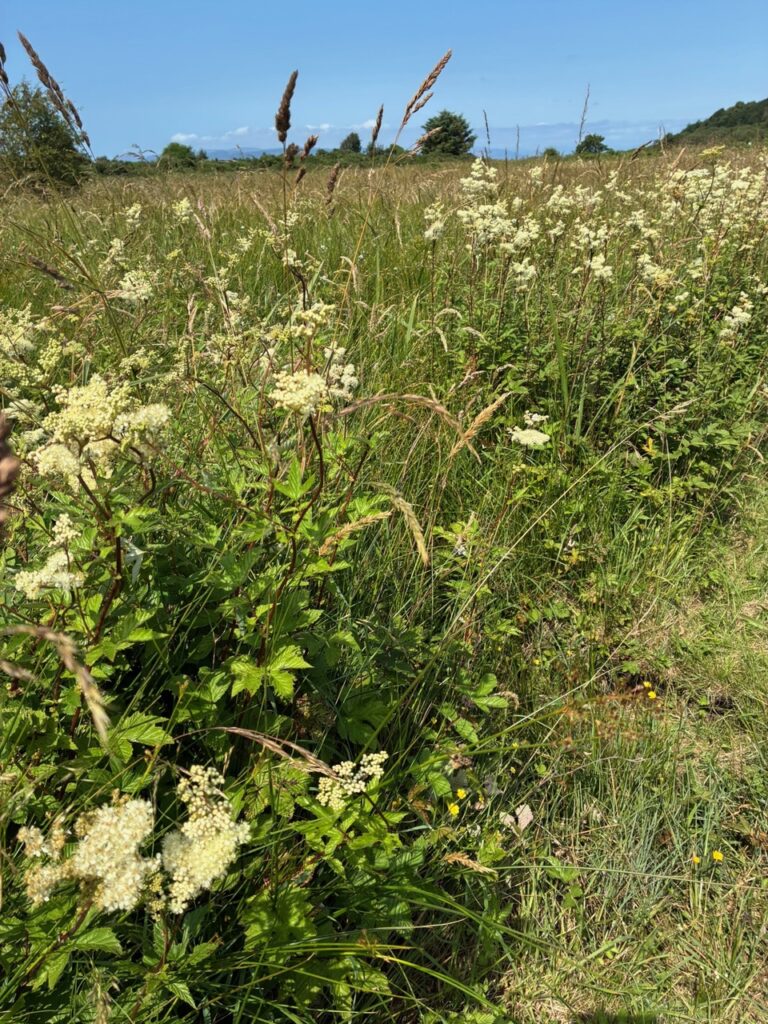
As we finished our tour, and browsed the wonderful collection of second-hand books, the grandparent in me was deeply grateful for the ‘no knobs, no buttons, no screens experience’ in this entirely app free zone. It felt quite special as we ambled down the Clyde walkway path leading to the river, leaving the musty olde world charm of the churchyard behind us. Here the wild geraniums were flourishing, the purple thistles were growing high, and the yellow meadowsweet scented the air. It held a timeless magical charm of where sacred lives had once lived and were now safely at rest.
Vikings and Skylarks on Cumbrae, is a story about Moranna, a Scots girl, who meets a Viking boy Sten, who lives on the island. They become friends, and share stories together, until the Battle of Largs in 1263 decides their fate. Richly illustrated and with fabulous reviews, purchase your copy now.

2 responses to “GLASGOW’S GOVAN STONES”
As usual an inspirational account of a memorable day out with your grandchildren. Thanks Maura for sharing that beautifully written piece!
I can’t wait to follow in your footsteps and experience that route for myself. So interesting and vividly explained.