The Friends Effect

Technology in the digital era has generally made life so much easier for everyone: information at our fingertips, complicated spreadsheets drawn up in seconds, and blood test analysis in minutes rather than days. That’s just a few of the benefits. We know we are on the brink of an intelligence revolution, but there are some things that just can’t be speeded up, or can they?  For example, learning a second language. No matter how well technology can translate rapidly on paper, and audio-visually, it can’t yet programme an individual to hold an intelligent conversation in a second language in any social situation. This is proving frustrating for young people, used to finding solutions instantly and not willing to put in the hard slog of foreign language learning of yesteryear.

From my own experience, even with more than 10 years of memorising verb endings and vocabulary, I found that I was struck dumb when having an actual French conversation. It took three months of total immersion in France before I could speak confidently.  I had studied up to Higher level at school in Glasgow before venturing to the South of France to work as an au pair for the summer. I was a student teacher and armed with my Collins Little Gem English/French dictionary and the encouragement of my fellow French workers at La Bonne Auberge in Glasgow’s Park Circus, I was on a mission to speak French fluently. No university degree course for me, just total isolation with a French family in a 10th century village in the heart of Provence.

When I was first shown around their home, and allocated the tasks to be undertaken, the sheer rapidity of their speech terrified me.  I nodded and acquiesced to everything. They could have been asking me to collect snails from the garden and cook them for lunch, and I would have agreed without flinching.  (This was a task I later discovered was left to their 9-year-old daughter. The snails, with shells removed, were put in a food-mixer and eaten in a ‘sauce aux tomates’ at least once a week).

Three months later, I was still nodding and agreeing to everything, and then something clicked. Like a magic key opening a door, I suddenly began to speak French without fear or inhibition. It happened on a Sunday afternoon while dining out ‘en famille au restaurant’, (a French tradition, I learned everyone did to show that ‘en France tout le monde mange comme un roi’ – everyone can eat like a king.)  After a couple of glasses of the finest Provencal wine, I found I could converse without hesitation.  The liquor helped of course, but from that day on, I lost the fear of making mistakes and I gained confidence in asking questions to clarify meaning.

Since then, I have topped up with conversation classes, watched lots of French films and I regularly converse with groups of French speakers. Its important to keep practising, but I am constantly  amazed at the variety of Apps, You Tubers and Instagrammers, who promise to provide language learning strategies with instantaneous results. In my view, it cannot be done.

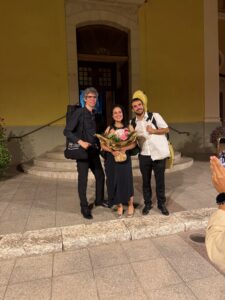
Recently, after a classical musical concert in the French town of Bandol on the Cote D’Azur, I spoke to a young award-winning clarinettist, Joë Christophe, from Paris. Not only was he keen to speak English, but of course, he wanted to come and play in Scotland. I asked him what his secret was for speaking such good English.
	“I studied English at school up to the age of 18 and then I gained a place at Le Conservatoire de Paris to study clarinet. All the classes at the Conservatoire were in French.  I felt this was crazy as I watched international students, from China, Japan and beyond, all English speakers, struggling to communicate in French. This was on top of the musical pieces they were studying. It was so difficult for them.
	“Once qualified, I was immediately asked to perform at concerts all over the world and the first thing I noticed was everyone spoke English. It was to my great shame and embarrassment, that I couldn’t communicate with anyone before or after concerts or in any social situation, unless they were French. The global language, no matter where you are, is English. I was so frustrated I had to do something to remedy this quick.
	“I looked on the internet, and what I found most appealing was the ‘Friends Effect’. By watching 10 seasons of Friends, in English, and at first with French subtitles, and later with English subtitles, you slowly become immersed in the language, and after 3 months, like magic, you can converse.”
This amazed me.  “So you mean by watching three months’ worth of Friends on Netflix, you become so absorbed in the language and situations, that it becomes embedded in the brain, and you can communicate?”
	“Absolutely, it leaves you feeling confident. You lose the fear of being laughed at for your pronunciation, and you can speak freely with everyday phrases. People respond like never before.”
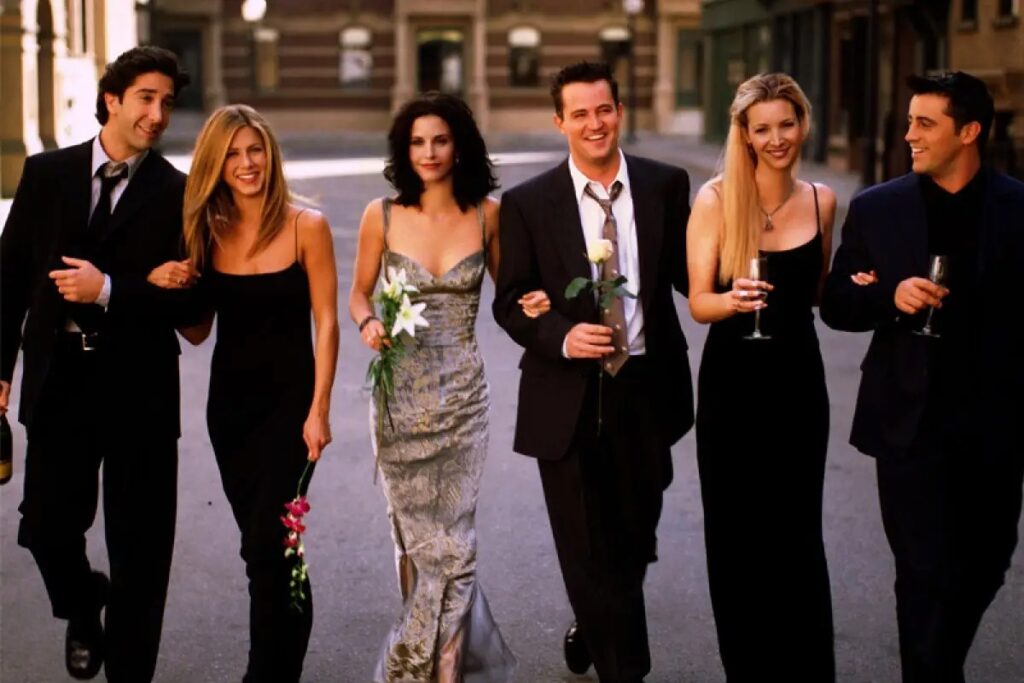
Indeed the Friends phenomenon is not new. The main rapper of the South Korean pop boy band, BTS, known as RM (Kim nan joon) famously learned this way too, ensuring when fame struck that he was the main English speaker for the group in interviews all over the United States.   He attributed his skill to Friends and his mother insisting he watched all 10 series. But perhaps it’s not just Friends. I notice too in the supermarkets in France, when once you wouldn’t hear a word of English spoken there is now a tendency for those working at the tills to start a conversation.  Just simple little phrases like “How are you doing? Have a good day, or where do you come from?” When I ask where they learned to speak English, they either say, “Peppa Pig” or “Friends”.  Both watched in English with French subtitles.

Courtesy of Jennifer Anniston and her ‘belles amis’, they have provided the best global second language learning tool of all time!  Oh how I wish I had had friends like these back in the day when I clutched my Collins Little Gem Dictionary so close to my heart.
One response to “With a Little Help from my Friends”
Who would have believed it? Watching a TV programme to become fluent in French! I may just try that when time allows. Certainly, I’ll be passing the tip along. Thanks Maura.